
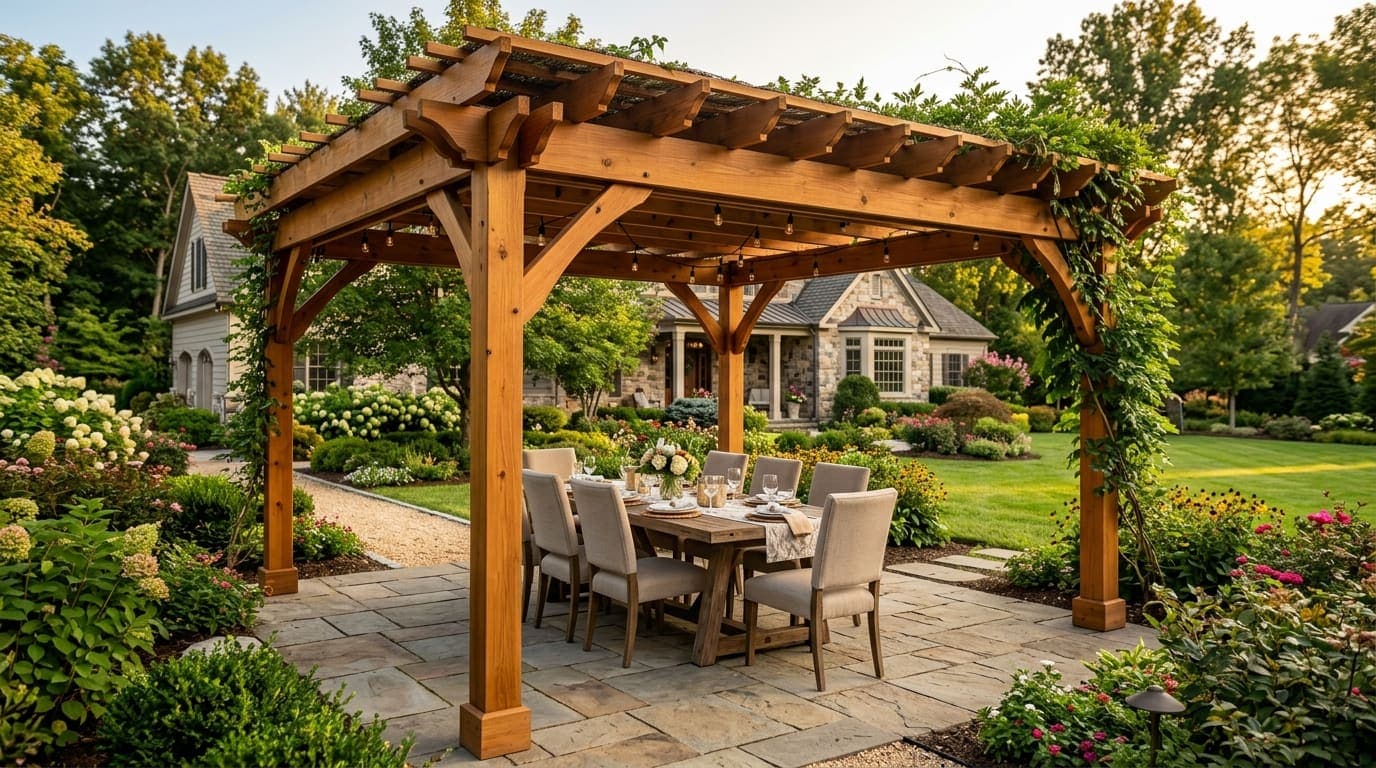
About This Service
About Our Covered Patio Structures Service
A covered patio structure occupies the productive middle ground between an open pergola and a full pavilion — providing meaningful weather protection without the visual weight and cost of a solid shingle or metal roof system. The most popular approach in this category uses polycarbonate panel roofing over a pergola-style frame: twin-wall or multi-wall panels that admit filtered natural light while providing full rain protection, UV blocking, and a significant degree of thermal moderation. The result is a bright, usable outdoor space that functions on rainy days and dramatically extends your patio season at both ends of the year. JHL Pergola & Carport Builders builds covered patio structures throughout Chester and Delaware Counties in a range of configurations to match different patio layouts, home styles, and budget requirements.
Twin-wall polycarbonate (16mm or 25mm) is the standard specification for covered patio applications. It provides excellent UV filtering (typically blocking 99%+ of UV-A and UV-B), reduces transmitted heat, and diffuses direct sunlight into an even, glare-free quality of light that makes the space comfortable even in direct afternoon sun. Available in clear, bronze tint, and opal (white diffuse) finishes.
What's Included
- —Structural frame in cedar, vinyl, or aluminum in attached or freestanding configuration
- —Polycarbonate panel roofing system (twin-wall, multi-wall, or solid polycarbonate depending on specification)
- —Aluminum extrusion glazing channels for panel retention and weatherproofing
- —Perimeter gutter channel and downspout system
- —Ridge flashing and end closure seals
- —Concrete footings poured to PA frost depth (minimum 36 inches) for freestanding configurations
- —Ledger attachment with waterproofing system for attached configurations
- —Permit research and application management
- —Site cleanup on project completion
How We Work
Our Process
Free Estimate & Site Visit
We visit your property, review site conditions, and provide a detailed written estimate at no charge.
Design & Permitting
We produce construction drawings and handle all permit submissions and municipality communications.
Installation
Licensed crew installation — no subcontracted labor. Footings, framing, and finish in sequence.
Inspection & Completion
We coordinate required inspections and complete a final walkthrough with you before sign-off.
Covered Patio Structures — Chester County Service Areas
Related Services
Covered Patio Structures — FAQs
What's the difference between polycarbonate and glass for a covered patio?
Polycarbonate is significantly lighter than glass (roughly half the weight for equivalent thickness), much more impact-resistant (it won't shatter), and easier to work with from a structural standpoint since it doesn't require the heavy framing glass does. It's also less expensive. The trade-offs are that polycarbonate can scratch more easily than glass and may yellow slightly over a very long time (20+ years) even with UV-stabilized coating. For residential covered patio applications, polycarbonate is almost always the right choice over glass.
Will a polycarbonate roof make my patio too hot in summer?
This is a common concern and it depends on the panel specification and sun exposure. Twin-wall polycarbonate with a bronze or opal tint significantly reduces heat transmission compared to clear panels and open air in full sun. In full afternoon sun exposure, a clear polycarbonate roof can create a greenhouse effect that makes the space uncomfortable — bronze or opal tint largely resolves this. JHL specifies the appropriate panel based on your patio's sun orientation.
Can you add polycarbonate roofing to an existing pergola frame?
It depends on the existing frame's structural condition and configuration. Polycarbonate panels require continuous glazing bars at a spacing matched to the panel width, which may not align with the existing rafter spacing. If the existing frame is in good condition and the rafter spacing can accommodate the glazing system, adding polycarbonate roofing is feasible. JHL will assess the existing frame before quoting a polycarbonate roofing conversion.
Does a covered patio structure require a permit in Chester County?
Yes. Permanent covered patio structures — whether attached or freestanding — require a zoning and/or building permit in most Chester and Delaware County municipalities. The presence of a roof (even polycarbonate) is what triggers the building permit requirement in most jurisdictions. JHL handles all permit research and applications.
How long does polycarbonate roofing last?
UV-stabilized twin-wall polycarbonate carries manufacturer warranties of 10 to 15 years against yellowing and significant light transmission loss. The actual functional lifespan is typically 20+ years for quality panel specifications. Corrugated polycarbonate at lighter gauges has a shorter lifespan, typically 10 to 15 years. JHL specifies commercial-grade UV-stabilized panels — not the thin corrugated sheeting available at hardware stores.
Can a covered patio structure be screened in later?
Yes. A pergola or covered patio frame designed with this in mind — with post spacing appropriate for screen panel installation and a solid perimeter header to receive screen frame attachment — can be screened in as a later project. JHL can design the initial covered patio structure to be screen-conversion-ready if that's on your longer-term plan.
Chester County, PA
Design Your Covered Patio Structures
Every project begins with a conversation. Tell us how you want to live outside.