
About This Service
About Our Outdoor Kitchen Pavilion Builder Service
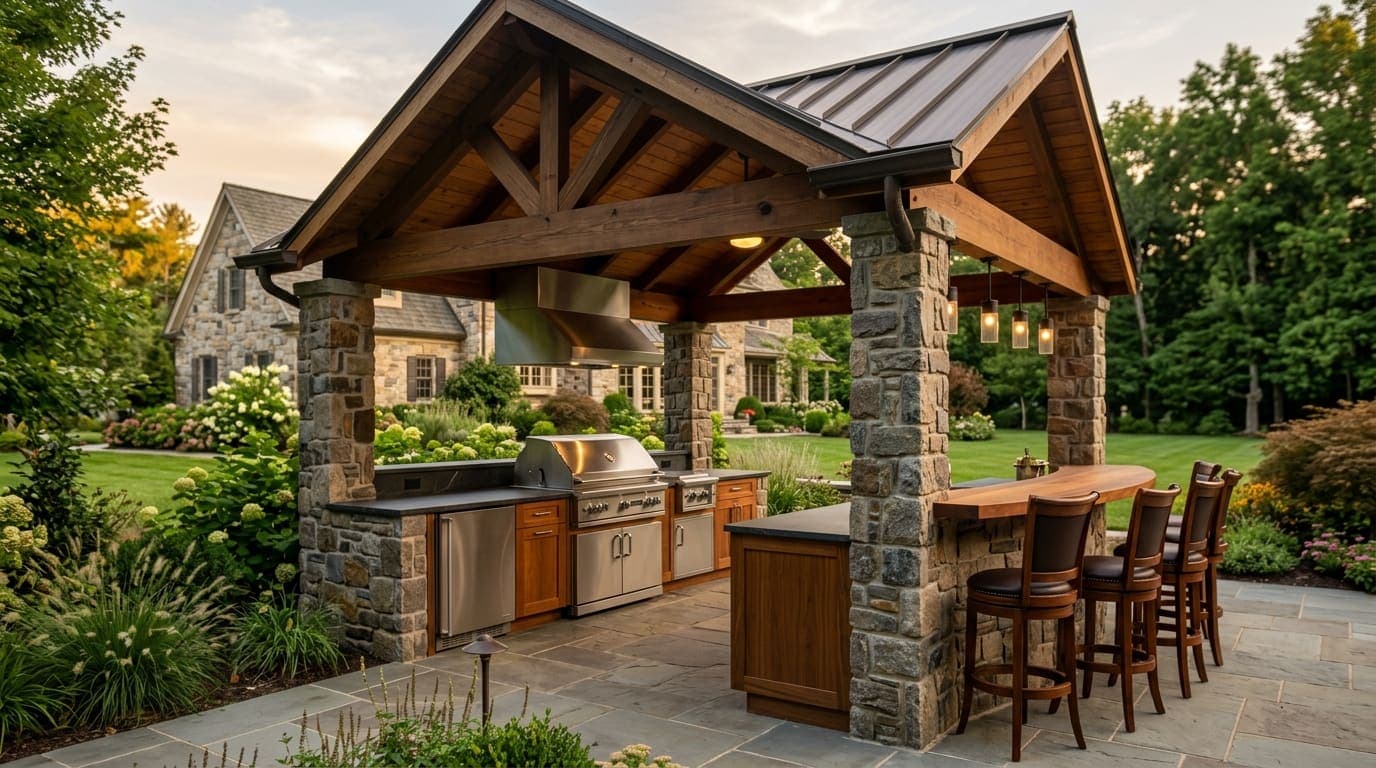
An outdoor kitchen pavilion combines the best outdoor structure with the most functional outdoor amenity — a weather-protected pavilion roof overhead and a fully equipped cooking and entertaining station below. This is the outdoor room that transforms a backyard from a space you occasionally use into a destination your household gravitates toward from the first warm weekend of spring to the last cookout of fall. JHL Pergola & Carport Builders designs and builds outdoor kitchen pavilions throughout Chester and Delaware Counties, coordinating every phase from structural framing and roofing through electrical conduit, gas rough-in, and kitchen component integration.
The pavilion frame for an outdoor kitchen application is sized to create a defined cooking and dining zone — commonly 16x20 to 20x24 feet to accommodate a kitchen counter run, a dining table, and seating. The roof structure is engineered for snow load and wind resistance appropriate for the site conditions, and ceiling height is designed to accommodate patio heater mounting at appropriate clearance above cooking surfaces.
What's Included
- —Pavilion structural frame (aluminum, cedar, or pressure-treated lumber)
- —Roof system in architectural shingles, standing-seam metal, or polycarbonate
- —Gutters and downspouts
- —Concrete footings poured to PA frost depth (minimum 36 inches)
- —Electrical conduit rough-in: outlet circuits, lighting circuits, ceiling fan junction boxes
- —Gas line stub-out to grill station location (coordination with licensed plumber)
- —Outdoor kitchen counter frame (aluminum stud or masonry block construction)
- —Countertop in porcelain, granite, or quartz (your choice of material)
- —Built-in grill rough-in and installation (grill supplied by homeowner or sourced by JHL)
- —Stainless refrigerator, side burner, and storage door rough-in and installation (optional)
- —Permit research and application management
- —Site cleanup on project completion
How We Work
Our Process
Free Estimate & Site Visit
We visit your property, review site conditions, and provide a detailed written estimate at no charge.
Design & Permitting
We produce construction drawings and handle all permit submissions and municipality communications.
Installation
Licensed crew installation — no subcontracted labor. Footings, framing, and finish in sequence.
Inspection & Completion
We coordinate required inspections and complete a final walkthrough with you before sign-off.
Outdoor Kitchen Pavilion Builder — Chester County Service Areas
Related Services
Outdoor Kitchen Pavilion Builder — FAQs
Does an outdoor kitchen pavilion require a building permit?
Yes. A pavilion with electrical and gas utility connections is a significant permanent structure and requires a full building permit in every municipality in Chester and Delaware Counties. The permit scope covers the structural frame, roof, electrical rough-in (inspected by the electrical inspector), and gas piping (inspected by the plumbing inspector). JHL manages the full permit process including all sub-trade inspections.
Can the outdoor kitchen be natural gas or does it have to be propane?
Either fuel works. Natural gas requires a new line run from your home's gas meter, which a licensed plumber runs as part of the project. Natural gas is typically the preferred choice for built-in grill applications because it eliminates the need to monitor and swap propane tanks. Propane is appropriate where running a natural gas line is not practical — for structures further from the house or on properties without natural gas service. JHL's plumber coordinates whichever fuel source is appropriate.
What countertop material works best for an outdoor kitchen?
Porcelain tile and sintered stone (like Dekton) are the top outdoor kitchen countertop choices for Pennsylvania's climate because they handle freeze-thaw cycling without cracking, are UV-stable, and are impervious to moisture. Granite performs well outdoors when properly sealed but requires periodic resealing. Standard quartz is not recommended for outdoor use — the resin binders in most quartz products are not rated for freeze-thaw exposure. JHL specifies appropriate outdoor-rated countertop materials and will steer you away from options that won't hold up in PA winters.
How is the outdoor kitchen counter frame built?
Outdoor kitchen counters are built on either an aluminum stud frame (lightweight, rust-proof, the current industry standard) or a masonry block (CMU) frame. Aluminum stud frames are faster to build, lighter, and are the standard for most residential outdoor kitchen applications. CMU frames are heavier but have a higher thermal mass and are appropriate for very large or commercial-grade outdoor kitchen setups. JHL uses aluminum stud framing as the standard and builds CMU frames on request.
How do you handle grease and drainage from an outdoor kitchen?
An outdoor kitchen grill station generates cooking grease that needs to drain somewhere. Built-in grills have internal grease management systems that collect grease in a removable drip tray — this is the most common approach and requires no drainage infrastructure beyond periodic drip tray cleaning. If a cocktail sink is included, a drain line runs from the sink to a subsurface dry well or connection to the home's sanitary system. JHL's plumber handles drain design and installation as part of the kitchen scope.
Can I add a fireplace or fire pit to the outdoor kitchen pavilion?
Yes, but the structural and utility coordination is more complex. A wood-burning fireplace requires a masonry or prefab firebox and a chimney that penetrates through the pavilion roof — the chimney location and clearances need to be designed into the structure from the start. A gas fire pit or fire table is simpler: a gas stub-out at the fire feature location and an appropriate clearance zone around it. JHL designs both configurations and coordinates the fire feature integration as part of the pavilion project scope.
Chester County, PA
Design Your Outdoor Kitchen Pavilion Builder
Every project begins with a conversation. Tell us how you want to live outside.